Learn about the key regional methane regulations in force as of May 2026 and how Optical Gas Imaging (OGI) supports compliance worldwide.
Methane has become one of the most scrutinized greenhouse gases in the energy sector, and for good reason. With a warming potential approximately 80 times greater than CO₂ over a 20-year period, methane represents both an urgent climate challenge and, increasingly, a direct operational and regulatory risk for oil and gas operators.
Three major frameworks are now reshaping how operators approach methane:
EU Methane Regulation – EU 2024/1787
The first-ever EU Regulation on reducing methane emissions in the energy sector (EU 2024/1787) entered into force on 4 August 2024. One of the most significant changes it introduces is the transition from emissions estimation to measurement-based reporting.
Operators are now required to implement structured Measurement, Reporting and Verification (MRV) systems. This means emissions data must be:
- Directly measured using approved methodologies
- Reported in a standardized format to national competent authorities
- Independently verified to ensure accuracy and transparency
The regulation also establishes mandatory LDAR programs for all oil and gas operators. It defines two types of LDAR surveys:
- Type 1 surveys target large leaks: components emitting ≥17 g/h of methane must be repaired
- Type 2 surveys are more sensitive: components ≥1 g/h must be repaired. A Type 2 survey can substitute for a Type 1 survey when the latter is due, but not the reverse
Minimum inspection frequencies by facility type:
| Facility type | Type 1 | Type 2 |
| Gathering & processing | Every 6 months | Every 12 months |
| Transmission & storage | Every 12 months | Every 12 months |
| Upstream / production | Every 36 months | Every 60 months |
When a leak is detected, operators must make an initial repair attempt within 5 days and complete full remediation within 30 days, followed by a mandatory verification re-survey. Personnel conducting LDAR surveys must hold recognized certification.
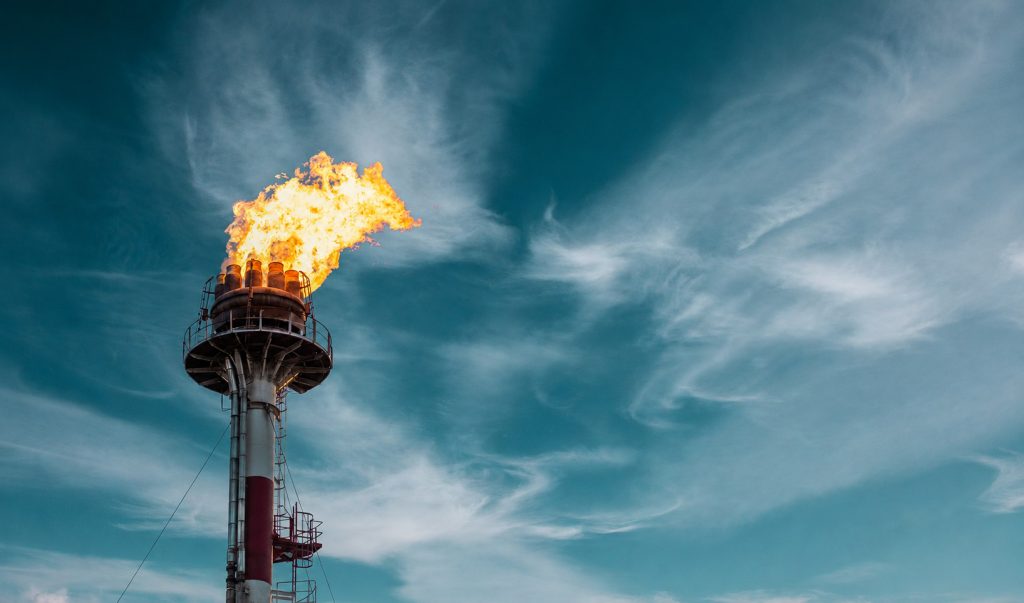
Regarding venting and flaring, the regulation introduces strict controls. Routine venting is largely prohibited. Flaring is no longer considered a routine operational practice and is only permitted under specific circumstances. Where it occurs, operators must justify each event individually and demonstrate a combustion efficiency of ≥98%.
Finally, the regulation delegates technical implementation to harmonized standards under development at the European Committee for Standardization (CEN). CEN/TC 264/WG 38 defines performance requirements for detection and quantification methods; CEN/TC 234/WG 14 addresses MRV requirements, LDAR and venting and flaring. SENSIA actively participates in both working groups.
OGMP 2.0
The Oil and Gas Methane Partnership 2.0 (OGMP 2.0) is a voluntary reporting framework facilitated by UNEP and the Climate and Clean Air Coalition (CCAC). It is not a regulation, but with over 150 signatory companies representing a significant share of global oil and gas production, it has become the de facto international benchmark for credible methane emissions reporting.
OGMP 2.0 defines a five-level hierarchy for methane emissions reporting, with increasing measurement rigor at each level:
- Level 1: Single aggregated emissions figure at company or asset level
- Level 2: Emissions by source category, using generic emission factors
- Level 3: More detailed source breakdown, still using generic emission factors
- Level 4: Source-specific data based on direct measurements or site-specific activity data
- Level 5: Level 4 source inventory reconciled with independent site-level measurements
Signatories commit to reaching Level 4 reporting, or above, within a defined timeframe. Levels 4 and 5 require direct field measurement rather than estimation, which is why OGMP 2.0 significantly increases the operational relevance of measurement and quantification technologies.
Although voluntary, OGMP 2.0 has been instrumental in shaping the direction of binding regulation, most notably the EU Methane Regulation, whose MRV requirements closely mirror the measurement standards of OGMP Levels 4 and 5.
EPA Methane Regulations
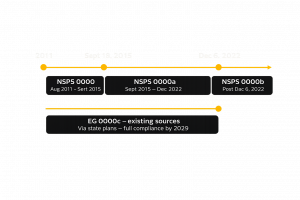
The United States Environmental Protection Agency (EPA) regulates methane emissions from the oil and gas sector through a series of rules commonly known as the “Quad O” regulations, a framework that has expanded progressively since 2012 into a comprehensive system of methane monitoring, reporting and emissions reduction requirements.
The framework dates to 2012 with the original OOOO rule, which focused primarily on VOC emissions and laid the operational groundwork for what followed.
- OOOOa: OGI designated as the standard (2016)
In 2016, EPA finalized OOOOa, extending the framework to explicitly regulate methane emissions for facilities constructed, modified or reconstructed after September 18, 2015. It was the first rule to designate Optical Gas Imaging as the Best System of Emission Reduction (BSER), establishing OGI surveys as the federal standard for LDAR programs. Under OOOOa, operators must conduct periodic OGI surveys (semiannual at most facility types), detect fugitive emissions, and complete repairs within defined timelines.
- OOOOb: Stronger requirements and new monitoring pathways (2024)
OOOOb applies to facilities constructed, modified, or reconstructed after December 6, 2022. Published in March 2024 alongside OOOOc, it strengthens LDAR inspection frequencies, with a baseline of at least two OGI surveys per year at many facility types, introduces a zero-emission standard for process controllers and formalizes Appendix K, the detailed protocol governing OGI survey performance, operator certification and field documentation.
OOOOb also introduces advanced monitoring as an alternative compliance pathway to traditional periodic OGI surveys. Operators can deploy continuous monitoring systems or periodic screening technologies meeting defined detection thresholds in lieu of standard OGI LDAR surveys. Continuous OGI monitoring systems represent one such pathway, providing operators with permanent emission visibility and the early-warning capability needed to stay ahead of both regulatory obligations and super-emitter events.
One principle holds across all pathways: OGI surveys can always substitute for any advanced monitoring method. The reverse is not true.
- OOOOc: Existing sources, for the first time (2024)
OOOOc is the first-ever federal methane standard applied to existing oil and gas infrastructure. Unlike OOOOa and OOOOb, which are NSPS rules directly binding on operators, OOOOc is an Emissions Guideline requiring states to develop their own implementation plans. Full compliance across the existing fleet is projected by 2029.
Methane monitoring in practice: SENSIA’s role across all three frameworks
As methane regulations become more demanding, compliance is no longer optional. The EPA, EU 2024/1787 and OGMP 2.0 are converging on the same requirement: emissions must be detected, quantified, reported, and verified. Generic detection-only programs are no longer sufficient.
This is the challenge that SENSIA’s Smart OGI solutions are designed to address, covering the full measurement chain, from leak detection to source-level quantification and continuous emissions monitoring.
Our global team offers:
- OGI and QOGI systems compliant with US EPA, EU 2024/1787 and OGMP 2.0
- Fully autonomous reporting software that centralizes data logging, streamlines regulatory reporting, and provides immutable certification to support compliance and traceability.
- Technical integration and commercial support for deployment at scale
- Access to RedLook Academy: our certified operator training programs aligned with emerging EU and international standards
With deployments across more than 55 countries and active participation in the CEN working groups developing the technical standards for EU 2024/1787, SENSIA provides the solutions and expertise needed to navigate complex regulatory transitions with confidence.